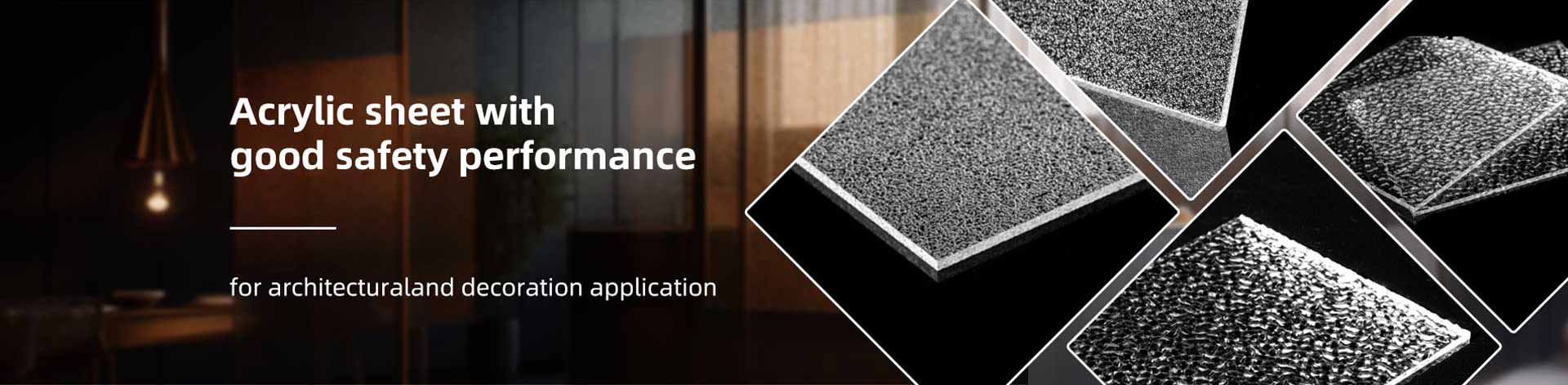
KUNXIN’s own product range includes Frosted Satin Ice Acrylic Sheet, and its application pages describe frosted acrylic as a material used for privacy, light diffusion, and decorative surfaces in interiors, lighting, and display projects.
KUNXIN’s PMMA product page states that clear acrylic reaches light transmission up to 92 percent, weighs only about half as much as glass, and can deliver impact resistance roughly 7 to 18 times higher than glass. KUNXIN’s comparison article also notes density around 1.19 g/cm³ for acrylic versus about 2.5 g/cm³ for glass, with acrylic showing significantly better impact tolerance.
KUNXIN states that its clear PMMA sheet can be recycled and reused by both physical and chemical methods, and its product pages repeatedly describe acrylic sheet as recyclable and environmentally friendly. Beyond plant-level scrap reuse, industry sources also note that PMMA can be chemically recycled through depolymerization, which converts acrylic waste back into methyl methacrylate for reuse in new material production.
KUNXIN’s own processing content states that acrylic can be laser cut, engraved, drilled, heat-bent, and polished, and its recent laser-cutting guides describe laser processing as one of the most precise and efficient methods for acrylic sheet fabrication.
KUNXIN’s own bonding guides explain that solvent cement is the most widely used solution for acrylic sheet, especially where clear joints, stable edge bonding, and clean appearance are required. Industry fabrication guidance says the same and notes that acrylic sheet is typically joined with solvent cement because the material is effectively welded at the joint line.
KUNXIN’s cleaning guidance says acrylic should be washed with clean water, mild non-abrasive soap, and a soft microfiber or cotton cloth, while other acrylic care references give the same recommendation and warn against harsh cleaners and rough wiping.
KUNXIN’s own UV guidance says acrylic sheet naturally filters part of ultraviolet radiation and can also be specially formulated to block more than 98 percent of harmful UV rays, which already shows there is a difference between standard acrylic and specially engineered UV-blocking grades.
KUNXIN’s own technical content gives acrylic density at about 1.19 g/cm³ and also notes that this low weight makes the material easier to handle, transport, and install in larger-format applications.
Industry references describe this as the core difference between cast acrylic and extruded acrylic, and KUNXIN’s own technical content shows that it works with both cast and extruded PMMA for different project needs.
KUNXIN’s own fabrication guidance says thin sheets up to 3 mm are commonly score-cut for straight processing, and its forming article says acrylic becomes soft and bendable at around 150 to 160°C. Standard PMMA data sheets also place tensile modulus around 3200 MPa and flexural modulus around 3300 MPa, which confirms that 3mm acrylic has controlled stiffness with limited natural flex.
KUNXIN’s recent fabrication content shows that the company supports CNC cutting, laser cutting, drilling, polishing, and edge finishing, and one of its cutting guides states that its CO₂ laser lines can reach ±0.1 mm accuracy for complex geometries.
KUNXIN’s acrylic fabrication content highlights custom drilling, CNC machining, cut-to-size processing, and OEM and ODM support for global projects, which makes drilling quality part of a broader manufacturing capability rather than a standalone workshop task.